
Leadership development
7 Signs Your Company Needs Leadership Development (And how to fix it)

When organizational performance drops, executive instinct often points to market volatility, broken workflows, or compensation gaps. Yet in high-growth enterprises across India, the GCC, and global markets, the real bottleneck is rarely strategy or operational tooling. It is leadership capability lag, the widening gulf between the complexity of the business and the behavioral maturity of the people charged with steering it.
Most organizations treat leadership development as an episodic reward: an annual offsite, a sporadic seminar, or a reactive remedy for an executive in trouble. But when capability gaps are addressed through one-off workshops, the systemic cracks remain untouched.
Leadership is not a personality trait; it is organizational infrastructure. When that infrastructure fails, the symptoms reveal themselves across balance sheets, attrition curves, and team velocity.
Here is how to identify the seven structural signs that your company needs to invest in leadership development, along with a blueprint to build sustainable, scalable leadership performance.
When does leadership development become urgent?
An enterprise must invest in structured leadership development the moment operational friction shifts from technical execution problems to relational, strategic, and succession bottlenecks. Specifically, if your frontline managers are causing attrition, mid-tier leaders cannot make decisions without executive escalation, your succession bench lacks ready successors, and team execution stalls amid cross-functional silos, the issue is not individual competence, it is the absence of a connected leadership capability infrastructure.
1. High turnover among high-performing individual contributors
People rarely leave companies because they dislike the product, the mission, or the brand. They leave because their direct managers have not been taught how to manage humans.
A classic corporate failure pattern is the "Accidental Manager" paradox: an exceptional software engineer, top-billing sales representative, or brilliant financial analyst gets promoted to people manager as a reward for individual excellence. Yet individual contribution requires technical competence, while leadership demands emotional intelligence, delegation, coaching capability, and psychological safety.
According to research synthesized across global workforce studies, nearly 60% of frontline managers step into managerial roles without formal leadership training. The result? Micro-management, chronic friction, and rapid disillusionment among their highest-performing direct reports. If your exit interviews repeatedly cite "lack of career direction," "micromanagement," or "opaque communication," you do not have a recruitment problem. You have an untrained frontline leadership tier.
2. Decision paralysis and the "executive escalation trap"
Does every non-routine operational decision require sign-off from the CXO suite?
When mid-level leaders lack strategic acumen, critical thinking frameworks, and decision-making confidence, they push decisions upward. This creates an Executive escalation trap:
Senior leaders become operational firefighters, spending 60% of their calendar arbitrating tactical disputes or approving everyday exceptions.
Mid-level managers operate as administrative relay switches rather than accountable business owners.
Organizational execution velocity grinds to a crawl because every decision queues at the executive desk.
When your leadership pipeline lacks systematic development, managers fear the vulnerability of making a call. Investing in structured leadership frameworks equips mid-level leaders with commercial acumen, risk calculation capabilities, and the situational judgment required to make high-velocity, autonomous decisions.
3. Manager Burnout and the "Squeeze" from Both Directions
The most stressed tier in any modern enterprise is mid-management. DDI’s Global Leadership Forecast notes that 71% of leaders experience significant increases in work-related stress, while overall manager engagement has plummeted across corporate sectors.
Mid-level leaders are trapped in an operational vise:
Executives demand relentless strategic throughput, cost efficiency, and transformation.
Direct reports demand empathy, well-being support, continuous feedback, and flexibility.
Without structured capabilities in prioritization, resilience, boundary management, and developmental coaching, managers attempt to bridge this chasm through raw, unsustainable effort. They do the work themselves rather than orchestrating team capability. When your managers appear perennially exhausted, cynical, or disengaged, telling them to "take time off" is a band-aid. They need targeted developmental support, coaching, and peer mentoring to transform from operational pack-horses into strategic orchestrators.
4. The "Empty bench": zero internal succession readiness
Examine your succession plan for critical CXO, VP, and Director-level roles. If a key business unit head left tomorrow, could you fill that vacancy from within 30 days?
For four out of five organizations, the answer is a definitive "No." DDI data reveals that only 20% of HR professionals express confidence in their organization’s leadership bench strength.
Organizations that neglect continuous leadership development become addicted to costly lateral hiring. External executive hires require massive recruitment premiums, take 6 to 9 months to hit baseline productivity, and carry a significantly higher failure rate due to cultural friction. An empty bench is definitive proof that your leadership development model is either non-existent or functioning as isolated event-based training rather than an integrated succession pipeline.
5. Cross-functional silos and tribal warfare
In most leadership cultures, leaders often define success within the narrow boundaries of their functional fiefdoms:
Engineering blames Product for unclear requirements.
Sales blames Marketing for low-intent pipeline.
Operations blames HR for hiring delays.
When leaders lack enterprise perspective, they view other departments as competitors for capital, headcount, and executive praise rather than partners in customer value creation. Enterprise leadership development breaks tribal thinking by training leaders in systems thinking, cross-boundary collaboration, and organizational alignment. A company where departments routinely work at cross-purposes is a company whose leaders have never been taught how to lead beyond their immediate functional silos.
6. The "Diversity cliff" at mid-to-senior tiers
Look at your company’s organizational chart. You may have near-gender parity and diverse representation across entry-level and individual contributor cohorts. But as you look toward Director, Vice President, and C-suite tiers, does diversity precipitously decline?
This phenomenon 'the Diversity Cliff' occurs when an organization fails to build intentional, structured development rails that support underrepresented talent through critical career transition points. Mid-career professionals, especially women leaders, frequently hit systemic barriers: a lack of executive sponsorship, exclusion from informal networks, and absence of targeted capability acceleration.
Relying on aspirational DEI statements without investing in targeted programs - such as high-potential women accelerator labs, executive sponsorship networks, and board readiness labs - ensures that the leadership demographic remains static and homogenous.
7. Change resistance and stalled transformation initiatives
Whether deploying enterprise AI systems, shifting to a new business model, or restructuring operating units, strategic transformations do not fail because the underlying technology is flawed. They fail because leaders at the front lines fail to manage the human dynamics of transition.
When managers lack change-leadership capabilities, they react to corporate transformation with:
Passive compliance (nodding in executive town halls, but changing zero everyday habits).
Defensive gatekeeping (protecting existing routines and legacy team structures).
Inability to translate macro-strategic visions into concrete team goals.
To survive continuous market disruption, leaders must be equipped with the capability to communicate ambiguity, cultivate psychological safety, and coach teams through continuous change.
The strategic diagnostic: symptoms vs. systemic solutions
Use this diagnostic matrix to assess where your leadership capability gaps reside and what targeted interventions are required:
Observed Enterprise Symptom | Root Cause Leadership Gap | Target Tier | Recommended Capability Intervention |
High attrition within 90 days of an internal manager promotion | Lack of people leadership fundamentals, active listening, and constructive feedback | First-Time / Frontline Managers | Structured First-Time Manager Accelerator combined with tactical peer mentoring |
Every tactical cross-team conflict escalates to CXOs | Inability to negotiate cross-functional priorities; lack of systems-level enterprise thinking | Mid-Level Managers & Directors | Mid-Manager Acceleration Lab & Cross-Functional Simulation Exercises |
High external search fees for senior leadership roles | Fragmented succession planning; lack of proactive executive readiness cultivation | Senior Directors & Functional Heads | CXO Readiness Labs, Executive Coaching, and Board Governance Preparation |
Gender/Diversity attrition at the mid-management pivot | Absence of formal executive sponsorship, visibility, and structured career navigation | High-Potential Diverse Talent | Women Pipeline Accelerators paired with Enterprise Mentoring Networks |
Strategic initiatives stall during team rollout | Change fatigue, inability to translate strategy into daily behavioral habits | All Management Levels | AI-enabled Continuous Coaching (Nexa AI Coach) for contextual behavioral nudging |
The architecture of leadership performance infrastructure
Moving away from the failed paradigm of disconnected, one-off training requires viewing leadership as an interconnected, scalable infrastructure.
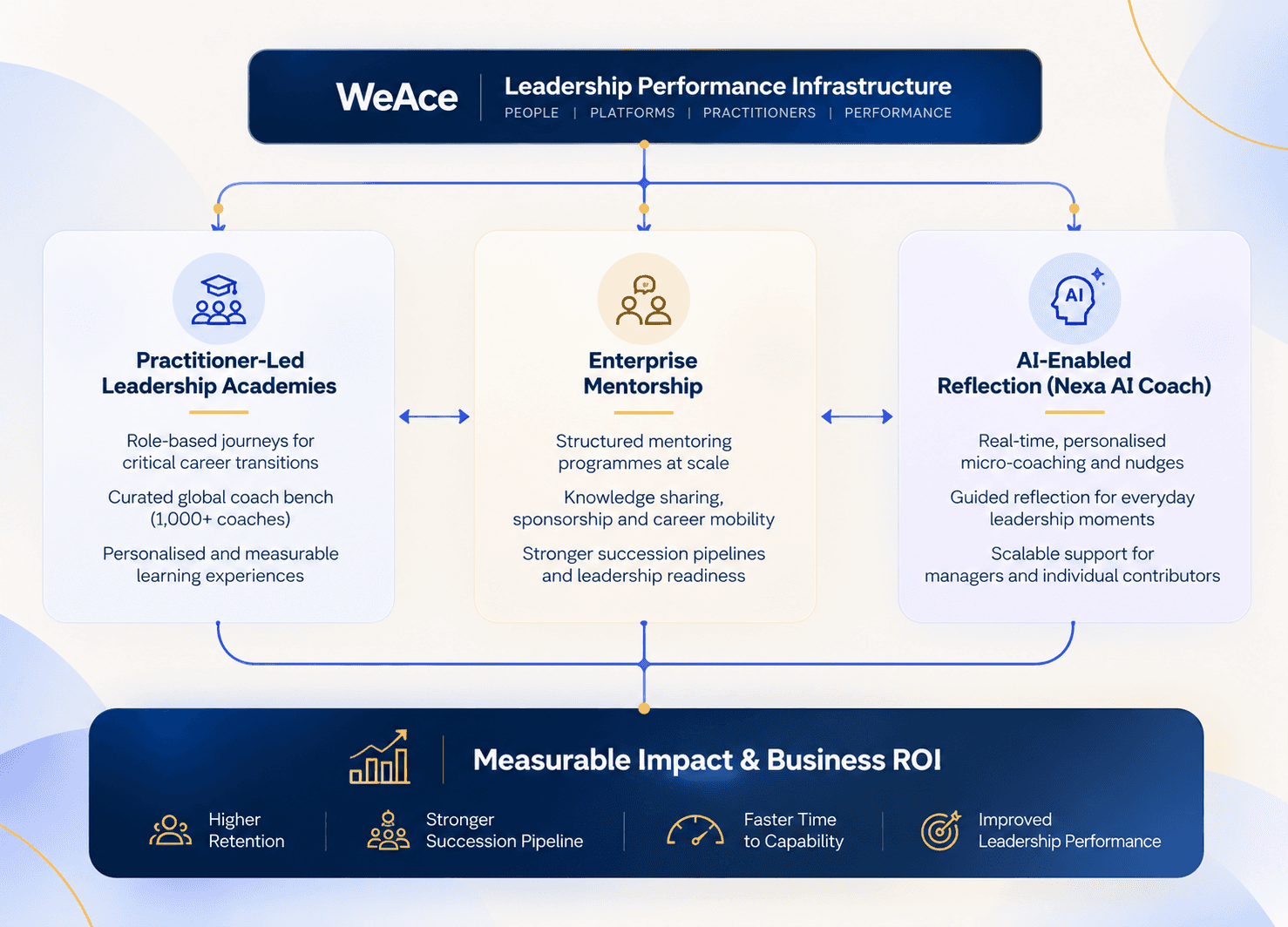
Practitioner-led accelerators: Structured, cohort-based experiential journeys targeting critical transition thresholds (First-Time Managers, Mid-Managers, CXO Readiness, and Women’s Leadership Pipelines).
Enterprise mentoring & sponsorship: Formalized organizational frameworks that connect institutional wisdom with emerging talent, creating transparent, measurable pathways for succession.
Continuous AI-powered coaching: Leveraging technology such as Nexa AI Coach to extend personalized reflection, scenario rehearsal, and behavioral habit reinforcement between human coaching sessions, ensuring development scales across the entire enterprise.
Data-driven progress telemetry: Moving beyond vanity metric survey scores ("Did you enjoy the workshop?") to measurable organizational outcomes: reduction in unwanted frontline attrition, velocity of internal promotions, and speed of cross-functional strategic execution.
Frequently Asked Questions
What is the ROI of investing in enterprise leadership development?
How do I know whether my company needs 1:1 executive coaching or cohort-based programs?
Why do traditional one-off leadership workshops fail?
Transform your leadership pipeline into a competitive advantage
Addressing leadership capability gaps cannot wait until an executive abruptly resigns or organizational growth stalls. When you treat leadership capability as essential performance infrastructure, you insulate your enterprise against market shocks, eliminate execution bottlenecks, and build a self-sustaining engine of strategic growth.
Ready to diagnose and strengthen your organization's leadership pipeline?
Discover how WeAce’s practitioner-led Accelerators, Enterprise Mentoring, and Nexa AI Coach empower high-growth enterprises to cultivate resilient leaders at scale.
👉 Explore WeAce Leadership Solutions | Schedule an Enterprise Capability Consultation